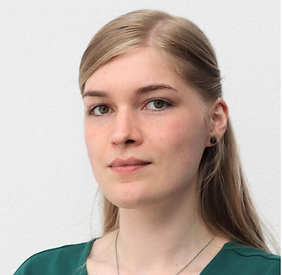
Eden Sophie Rimbach
Eden Is a journalist with the Werra-Rundschau newspaper and extensively covered the Stolpersteine laying ceremony both before and after it took place, ensuring that many of the local population would be aware of the importance and meaning to laying stolpersteine.
She was born in 1997 in Reichensachsen, a beautiful small town in Hesse and currently still lives there. After graduating from high school in Eschwege, Eden studied in Kassel, at the University of Marburg, graduating in 2022.
She started her career as a freelance journalist for the local Werra-Rundschau newspaper in April 2012 and has been employed by that newspaper in the role of editor/reporter since February 2024.
Personal Reflections:
My impression of the ceremony was that the people who organized it and took part in it all did really well. Seeing the pupils remembering the people behind each Stolperstein and paying their respects was touching, and looking back it felt like seeing that the younger generation in Germany (sadly not every young person in the country, but definitely the pupils who took part in Sontra) knows that all people are the same and deserve to be treated with love and respect, while some of our ancestors were unable to realize this. I also think that it was important that pupils, family members and people who keep learning more and who teach others about the history of Jewish families in Sontra and the entire Werra-Meißner-Kreis organized the ceremony together. The fact that the police had to be around made me personally scared for our future as a society because I also know that the police needs to be nearby whenever there is a ceremony in the synagogue of Kassel. As a Christian I cannot imagine what it is like to be afraid whenever you simply go to church.
It stood out to me that the people who attended the Stolpersteine ceremony got the chance to learn more about the people and the lives behind the names and dates on the Stolpersteine. I think that it is crucial to not only name when someone we remember was born, where they lived and where and when they died, but to really give the people the chance to get to know them. Hannah Kahlberg talking about her great-grandma Mirjam Kahlberg definitely stood out to me and I remember how I was able to imagine almost seeing and hearing Mirjam Kahlberg while listening to Hannah Kahlbergs words. It also stood out to me how the pupils laied down photographs and white roses to honor and remember every person behind a Stolperstein.
Given the amount of people who attended the event and the way that one could tell that it was important for them to take part, I think that it was important for a lot of people from the city of Sontra and the smaller towns nearby.
I do not recall receiving feedback from my colleagues for most of the articles, but one colleague told me that she thought the interview with Mr. Luber and Mr. Lasnitzki was really interesting and well written. I think this was the first time she said that about an interview I wrote. To me, it played a vital role that both of them were willing to share the stories of their families. I am also very thankful that Mr. Arnold mad the interview possible.
My hope is that my work gave the people who were unable to join the ceremony the opportunity to somewhat take part by reading the articles. To me, it is crucial to say the names of the people who were killed or who had to leave their homes because of the nazi terror. It is important that they and their names are not forgotten, which is why every name was mentioned at least once in the article about the ceremony. I also hope that people who read the interview and the articles will understand how important it is to not let the cruel and horrible things of the past happen again.
I think that seeing pupils and family members remembering together at the ceremony did shape how I think about reconciliation (see first answer). I talked to one of the students today, and her reaction when I told her how much her and her classmate's part taking in the ceremony meant to the family members was so pure. I could tell that at this moment she deeply understood what (in her case) showing the picture of a person and by that remembering them, their live and everything they went through meant to their family.
I would like to thank everyone who came to Sontra and who was part of the ceremony via video calls or through pictures send via phone. I am beyond thankful for meeting you and/or seeing how important this very day was for you. A sentence that was on my mind during the ceremony and that still sticks with me is what Mr. Luber said in the interview: "The Stolperstein finally is his (his grandfather's) place." To me this illustrates how something that has always been normal to me - I remember visiting the graves of nearly all of my great-grandparents and my grandfather who passed away shortly before my first birthday regulary as a child and both of my grandfathers are buried in the town where I live - was taken away from families. Also the chance of having a place where their descendants can remember them, was brutally taken away from your ancestors as were their very lives and the futures that would have been ahead of them. Words can not express the empathy I feel and how deeply sorry I am. It is important to me to thank all of you again for talking about your families and their history so openly - especially thank you to Mr. Lasnitzki and Mr. Luber. I know that the ceremony was really emotional for all of you and I appreciate that you still took the time to answer all of my questions. I hope that 2026 will be a great and blessed year for you and your loved ones.