A WALK THROUGH MEMORY LANE
SONTRA AND BEYOND

On the morning of Monday, 1 September 2025, our family gathered quietly outside the Adam von Trott School in Sontra.
It was early - just after 8:00 a.m. - and the day carried a sense of anticipation. We were not simply beginning a tour; we were stepping into layers of our own history.
As we walked toward the school, we passed what was once the last Jewish day school in Sontra. For many of us, that short walk was our first tangible reminder that Jewish life here had once been vibrant, ordinary, and deeply rooted.


Before the school day began, Ludger Arnold led us to a place few expected to find on school grounds - a Jewish cemetery. He explained that around 1920–1922, a new cemetery had been opened closer to town on the gentler slope of Quesselsberg. Between 1926 and 1937, at least 26 members of the Jewish community were buried there. During the Nazi era, the cemetery was largely destroyed. Only seven gravestones survived, later gathered and relocated to form a memorial site within the school grounds.
School Cemetery Presentation by Ludger Arnold
What struck us deeply was not only the history, but the respect still shown today. The cemetery gates are closed from Friday afternoon until Sunday morning, in observance of Shabbat. That this tradition is honored on a German school campus left a deep impression on many of us.
We were then welcomed into a school meeting room by Oliver Methe, the school principal. Waiting for us was a generous spread of biscuits, savouries, coffee, and tea, a small but heartfelt gesture of hospitality.
Mr. Methe explained the origins of the school’s name. Adam von Trott was a member of the German resistance against the Nazis, a man who paid for his courage with his life. The school carries his name as a reminder that even in the darkest times, there were those who stood against evil.
School principal welcome speech.
Mr. Methe spoke passionately about how the school teaches the Holocaust, not as distant history, but as lived reality, rooted in local stories. In this context, our Stolpersteine laid in Sontra are of enormous importance. They ensure that names are remembered where lives were once lived.
The family then split into four smaller groups and entered classrooms to speak directly with students. We told them about Jewish life in Sontra before Hitler, and what became of the families afterward. The children listened with curiosity and seriousness well beyond their years. Many of us hoped, and believed, that these stories would travel home with them, carried into conversations with parents and friends, extending remembrance beyond the classroom walls.
What we later learned made this experience even more powerful: the schoolchildren themselves had organized a waffle sale to help fund one of the Stolpersteine. In response, the Heilbrunn/Rothschild family decided to donate €500 to the school, to establish a five-year annual prize dedicated to Holocaust history. The school proposed using the funds to support one project each year, initially to raise public awareness of the ten Stolpersteine that were laid in Sontra on September 1. The biographies of the individuals commemorated by these Stolpersteine are to be made digitally accessible.
This would involve both the revision and expansion of the existing biographies, which were read aloud during the ceremony, and the development of ways to make this content digitally available. The involvement of the school and its students was profoundly uplifting. It became clear that remembrance here is not symbolic - it is alive.
Wichmannshausen:

After the Stolperstein ceremony, we travelled to Wichmannshausen, where we stood in front of Ringstraße 4, the former Heilbrunn House.
According to the meticulous research of Hans Isenberg, the house was built around 1690 and purchased by Victor Heilbrunn in 1795.
It remained in the family for more than a century, passing through generations until it was sold around 1927.
Within its walls, 23 children were born to the families of Meier Isaak and Liebmann Heilbrunn.
The current resident, who has lived there for over 60 years, welcomed us warmly. She spoke only German, with her words translated by Brian Luber, but meaning crossed language easily. For many of us, standing there felt like standing inside a family album, one made of stone instead of paper.

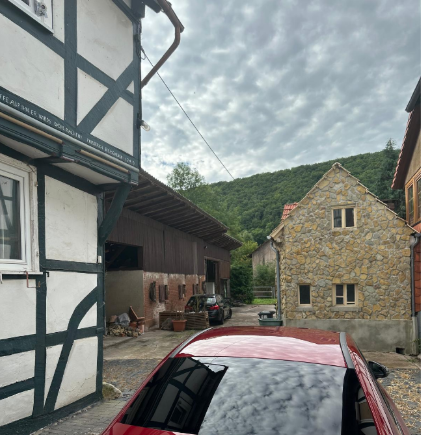
That evening, Lea Schellhase, her family, and friends organized a gathering at a traditional Grillhütte, nestled in the hills surrounding Wichmannshausen. A German "Grillhütte is a small, enclosed or semi-enclosed shelter specifically designed for socializing and cooking around a central fire pit or BBQ. They are often found in parks, forested areas, or private gardens. Around 40 people shared an abundance of food - meat, fish, vegetables, and desserts - prepared with care and generosity. Laughter, conversation, and quiet reflection filled the air. It was the perfect close to a day that had been intense, emotional, and unforgettable.


The Old Cemetery and the Weight of Silence
On Tuesday morning, we visited the old Jewish cemetery on the outskirts of Sontra, perched on a steep hillside. The climb itself told a story. Before motor vehicles, carrying coffins and mourners up such a slope would have been painfully difficult — a stark reminder of the historic antisemitism embedded even in burial practices.
Some gravestones were nearly unreadable, worn smooth by time. Others still spoke clearly. Among the most moving were the graves of Meier Heilbrunn, the family patriarch, and his infant son Victor, who lived only eight months. Standing there, names ceased to be abstract. They were family.

Here lies
Rav Meir son of Eliezer,
the honored Meir Heilbrunn.
He passed away on the 13th of Cheshvan
and was buried on the 15th of the same month,
in the year 5668 (1907).
Respected with honor in the community,
they mourned him and cherished him.
May his soul be bound in the bond of eternal life.

Here lies Victor Heilbrunn
Born 17 March 1897
Died 29 November 1897
Synagogues: Echoes of Prayer
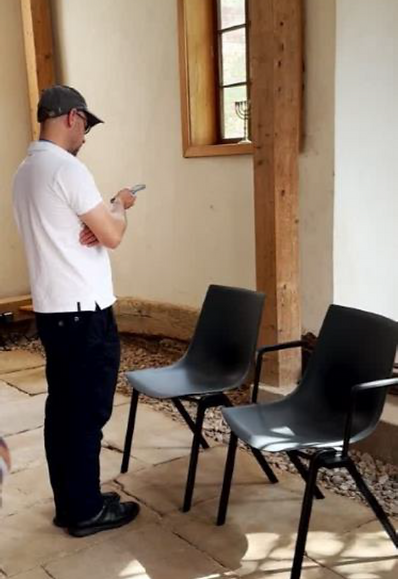
We visited former synagogues in Harmutsachsen and Abterode. In Harmutsachsen, Daniel Heilbrunn davened Mincha, returning prayer to a space that had not heard it in generations. The building was in disrepair, but it was noticed that a menorah stood in the window and the Hebrew message above where the Aron Kodesh once stood was evident
With the efforts of Ludger Arnold and the Friends of Jews Association, plans are underway, subject to funding, to restore these synagogues as memorials to the Jewish communities that once filled them with life.


The torah cover was recently found on ebay, purchased and relocated to the synagogue at Harmuchsachsen.
The translation of the cover is:
“Crown of the Torah.
This is the donation of his wife, Mina Nidlis,
for the elevation of the soul of our son,
on the occasion of his Bar Mitzvah,
1st of Iyar, 5635 (1875).”
Per Ludger Arnold this Torah cover that was stolen from the synagogue in Herleshausen during Kristallnacht in 1938. It resurfaced in the 1980s, but then disappeared again. Two years ago they were suddenly offered for sale on eBay in Wiesbaden.
Martin Arnold acquired them there, and had them partially restored, which was financed by donations.
The Abterode synagogue, built in 1871, has survived in another form, having been renovated in the early 1990s. Abterode itself is listed at Yad Vashem in the Valley of Destroyed Jewish Communities, a reminder that even small towns are part of a vast, shared history.

FORMER SYNAGOGUE
of the Jewish community of Abterode
Built in 1871.
Since 1944 owned by the Savings and Loan and Association of Abterode. Branch of the Raiffeisenbank Meißnervorland eG, which thoroughly renovated the building in 1992/93, after it had previously been used as a pay office and storage facility.
In memory of the fate of the Abterode synagogue and its community, Abterode is listed in the memorial site in the Valley of Destroyed Jewish Communities “Yad Vashem” in Israel.
The Mayoral Office
The last activity was a visit to the mayoral office. The group received a hospitable welcome by the mayor of Sontra, Mr Thomas Eckhardt who presented the Group with a plaque as a gift.


Valuable time was also spent in the archives with Frau Liane Vogel viewing and obtaining copies of birth, death and marriage certificates of some of our ancestors.
For Those Who Come After Us
This journey was not only about remembering loss. It was about connection, responsibility, and continuity. We walked where our ancestors lived, prayed, celebrated, and were buried. We spoke their names aloud. We watched children, German children, take ownership of remembrance.
For those who read this in years to come: know that in September 2025, your family stood together in Sontra. We remembered. We were welcomed. And we ensured that these stories would not fade.