Stolperstein is Finally His Place
Monday Interview with the Descendants of Jewish Families from Sontra
Written by: Eden Sophie Rimbach in Werra-Meissner on Monday 4th August 2025
Memorial Stones for Jewish Families
The fate of ten Jewish residents from Sontra is being commemorated with ten “Stolpersteine” (stumbling stones). The installation by artist Gunter Demnig, scheduled for Monday, September 1, carries deep significance for the descendants of the Heilbrunn and Rothschild families.
18 family members from Australia, Israel, and the USA will travel to Sontra to attend the ceremony. In an interview, Brian Luber and Milton Lasnitzki share how their families’ history was passed down and what the Stolpersteine mean to them.
How Was Your Family History Discussed?
Brian Luber: My mother, Gretl Luber (née Rothschild), told us about her past. She never forgot what happened, yet she lived her life. Our families were very closely linked, three marriages between the Rothschild and Heilbrunn families created strong bonds. Most emigrated to South Africa early on, then moved to Australia in the 1980s. The connection has only grown stronger across generations.
Milton Lasnitzki: My family’s history means a lot to me. I’ve developed a family tree tracing back to the 17th and 18th centuries. I don’t want future generations to be unaware of what happened. They should know where they come from and see that their story continues.
What Do You Know About Your Parents’ Childhoods?
Luber: My mother had only fond memories of Sontra. Born in 1921, she left the town in 1936 with her parents. She spoke often of playing in the woods and enjoying barbecues there. Her father, a tall man and horse trader, often went ice skating with her. There are many school photos, she had both Jewish and non-Jewish friends. My father Peter Luber, on the other hand, grew up in Hamburg and was not religious.
Mr. Luber, You Later Visited Sontra With Your Mother. What Was That Like?
Luber: I worked in Germany from 1975 to 1979. In 1978, my parents, brother, and I traveled across the country, from my father’s hometown to Sontra. In Sontra, my mother shared memories, though it took a while to recall them. We had no Google or local contacts back then, so all we found was the cemetery.
Was It Difficult for Her to Return?
Luber: Her traumatic experiences occurred after leaving Sontra in 1936. They fled to Holland, thinking they’d be safe. My grandfather was murdered in Bergen-Belsen concentration camp, and my grandmother died of illness in Tröbitz after liberation. My mother survived. Later, when I considered a job in Germany, I asked her and she encouraged me: “Yes, do it.” I think many in her situation wouldn’t have said that.
You Returned to Sontra in 2019?
Luber: Yes, we visited Hamburg, Bergen-Belsen, and Sontra. By chance, we found my grandmother Meta Rothschild’s grave. That was unexpected. In Sontra, we had better support from the city and could learn more, thanks also to Milton’s family tree. Digital communication really helped us connect worldwide.

Photo Caption
Childhood in Sontra 1927: This photo shows (from the bottom) the cousins Walter Rothschild, Manfred Heilbrunn, Edith Lasnitzki, née Heilbrunn, Gretl Luber, née Rothschild, Edith Lazarus, née Rothschild, Miriam Kahlberg, née Heilbrunn, Meier Heilbrunn, and Hans Rothschild. On September 1, Stolpersteine (memorial stones) will be laid for Gretl Luber, Miriam Kahlberg, and Meier Heilbrunn; further ones for Manfred Heilbrunn and Edith Lasnitzki are planned to follow.
Are You Both the Ones Most Involved in Researching Family History?
Lasnitzki: Yes, I’ve been researching for over 30 years. But the Stolpersteine project began when Lea Schellhase contacted me for her research, facilitated by Hans Isenberg. That sparked the idea of remembering our families with Stolpersteine. The support from Lea Schellhase and Ludger Arnold (from the Friends of Jewish Life Association) was essential. Plans for more Stolpersteine already existed.
Luber: Initially, 14 stones were planned; 10 will be placed now, and the remaining four will follow. 18 relatives will attend, while others couldn’t due to age or illness.
What Is It Like for You to See Stolpersteine in Germany?
Lasnitzki: I see Gunter Demnig as a hero. It’s a very meaningful project. These stones remind us why our families had to flee. I wouldn’t be here otherwise.
Luber: I’ve seen many Stolpersteine in Hamburg and Berlin big cities are perhaps further along in commemorating murdered Jews. It’s moving to see them in a small town like Sontra. It’s a great project, even if some people ask, “Why do they do that?”
How Do You Feel About the Ceremony on September 1?
Lasnitzki: These stones will honor my ancestors. It’s important for me to preserve their memory. By attending, we’re showing them respect.
Luber: This is where it all began in Sontra. Our family stories stretch across continents and generations, but they all lead back to this town, these homes, these lives now marked by Stolpersteine. This return is not just about remembering the past, it’s about honoring the resilience, love, and legacy of those who came before. We remember them with pride and gratitude and carry their stories forward. I will say that at the ceremony. My grandfather Hermann Rothschild never had a grave, only a mass grave in Bergen-Belsen. For my brother and me, his Stolperstein is finally the place where he can be remembered.
Brian Luber was born in Johannesburg, South Africa, in 1951.
After studying engineering, he worked at Siemens. He was in
Germany for five years on business, and also had the opportunity
to travel the world through work. He has lived in Australia since
1979, and later the rest of his family moved there as well.
His father Peter came from Hamburg and emigrated to South
Africa in 1936. Luber's mother Gretl, née Rothschild, came from
Sontra, as did her parents Hermann and Meta, née Heilbrunn.
They will soon be remembered with stumbling stones. Hermann
Rothschild's father Wolf was also born in Sontra, Meta Rotschild's father Meier Heilbrunn in Wichmannshausen.

Milton Lasnitzki was born in 1950 in Nigel, South Africa.
He has lived in Melbourne since 1988. Lasnitzki is married
and has three sons and six grandchildren. He graduated
as a chartered accountant in Johannesburg and has
worked mostly for companies, including management.
His father Heinz came from Berlin, his mother Edith
Heilbrunn was born in Frankfurt am Main, but lived in
Sontra before emigrating to South Africa with her parents
and brother in the 1930s. Her father Leopold came from Sontra, Leopold's father Meier Heilbrunn was born in Wichmannshausen and died in Sontra.

Sontra – “They had lives, hopes, joys, fears, and everyday routines,” Lea Schellhase translated the words spoken by Milton Lasnitzki as he remembered his grandparents Leopold and Lieschen, née Heineberg. Also commemorated were Leopold’s mother Cäcilie, née Cohn, her son, Hugo Heilbrunn, his wife Helene, née Rothschild, and their children Miriam (Heilbrunn) Kahlberg and Meier Harry Heilbrunn.
These lives were violently destroyed for Jewish families from Sontra through persecution under National Socialism, often under mortal threat. In 1933, Cäcilie was already 76 years old when Meier Harry, then just 17, fled with his family to South Africa, where they survived the Holocaust.
Today, Stolpersteine (stumbling stones) in Sontra commemorate ten members of this Jewish family. The profound significance of these memorial stones for the descendants was powerfully conveyed in the deeply moving words of Milton Lasnitzki, who travelled from Australia. He comes from the Heilbrunn family, which was represented at the ceremony by 19 relatives who came together to trace a family history whose impact is still felt today - both past and present. In total, 348 members of the family were murdered during the Holocaust; many others were forced to flee.
The Heilbrunn and Rothschild families were closely connected through marriage and their children. Leopold and Lieschen Heilbrunn lived in Sontra, while the Rothschild family resided in the neighboring town of Netra. Brian Luber recalled the house with its large, distinctive gate, which he remembered from his grandfather - one of Leopold’s brothers. “We were merchants, craftsmen, employees,” he said. “I was deeply religious; everything here in Sontra was shaped by faith.” The families’ lives, he added, were torn apart in a tragically brutal way.
The Rothschild family fled to the Netherlands, where they went into hiding and lived in constant fear. Grandmother Regine Rothschild eventually managed to escape to South Africa. Gretl and her parents were interned in the Westerbork transit camp and deported in 1944 to Bergen-Belsen. Her husband was shot by resistance fighters. Meta fell gravely ill during the so-called “lost transport” en route to the Theresienstadt ghetto. Meta died there as a result of starvation.
Through short biographies, photographs, and the laying of white roses, students from Sontra and
Remembrance in Solidarity
Descendants and many visitors attend the laying of Stolpersteine in Sontra
Written & photo by: Eden Sophie Rimbach in the Sontra News on Wednesday 3rd September 2025

Photo Caption
A memorial site has been dedicated to the memory of ten members of the Rothschild and Helbrunn families in Sontra. Also present (from left) were the descendants Brian Luber and Milton Lasnitski, who attended the laying of the memorial by Günter Demnig. Among them was also Sophie Ribbach.
pupils from the Adam-von-Trott School and the Rhenanus School honored the victims. Hannah Kahlberg, also a great-granddaughter of Mirjam (Heilbrunn) Kahlberg, shared her great grandmother’s story. She traveled from Australia with her family to show her respect. Altogether, 19 relatives - ranging in age down to the youngest at 25, attended the Stolperstein ceremony conducted by artist Gunter Demnig.
Many family members sent photographs and videos in advance, and some joined via video calls so that relatives unable to travel could still participate. Heartfelt thanks were expressed to organizer Ludger Arnold and the City of Sontra, as well as to all involved churches and the working group at Sontra Grammar School. Special recognition was given to school principal Oliver Methe, music teacher Wolfgang Kulks, and musician Volker Positi. Appreciation was also extended to Mayor Thomas Eckhardt for his strong personal involvement. Lea Schellhase was praised for her outstanding research contribution to the Stolperstein project, demonstrating, as was said, “the fruits that emerge when one looks closely and carefully.”
Descendants and visitors at the laying of the stumbling stone in Sontra
Written by: Eden Sophie Rimbach in the Werra-Rundschau on 30th September 2025 Photo by: Eden Sophie Rimbach
92 years after Hitler's seizure of power, stumbling stones commemorate the lives of seven Jewish citizens in Sontra. They tell their story.
"They had a life, hopes, joys, fears, routines," Lea Schellhase translates the words Milton Lasnitzki says about his grandparents Leopold and Lieschen, née Heineberg, Heilbrunn, his great-grandmother Cäcilie Heilbrunn, née Cohn, her son Hugo,= and his wife Helene, née Rothschild, and their children Mirjam Kahlberg and Meier Harry Heilbrunn.
Thier life in the house at Bahnhofstraße 5 changed for the Sontra family with the beginning of the Nazi regime and came under increasing danger. In 1933 – grandmother Cäcilie was 76 years old at the time, grandson Meier Harry 17 – the family fled to South Africa, thus surviving the Holocaust.
"With Hitler in power, life became unbearable"
Now, 92 years later, stumbling stones commemorate the lives of these seven Jewish citizens of Sontra. How deep the meaning of this memory is for their descendants was visible and tangible when the stumbling stone was laid. Milton Lasnitzki from Australia said in front of the former home of the Heilbrunn family that he felt the presence of history in this place - both that of this time and personally that of his ancestors. About 348 members of the family were murdered in the Holocaust, many more were expelled and fled.
The Heilbrunn family was closely connected to the Rothschild family through three marriages between children of the families. Yesterday, Hermann and Meta, née Heilbrunn, Rothschild and their daughter Gretl Luber have been commemorated by stumbling stones in front of their former house in Niederstadt 16. Gretl's son Brian Luber reminded us in front of the building with the large gate, which is still striking today, how his grandfather, a respected Husband, worked here as a horse dealer. "He was a very religious Jew," he said, in Sontra there was everything to live the religion at that time. But: "With Hitler in power, life became unbearable."
Jewish family from Sontra flees to Holland – some lost their lives
The family fled to Holland because it had remained independent during the First World War and grandmother Regine Rothschild was too old to travel to South Africa. Gretl and her parents were interned in Westerbork and deported to the Bergen-Belsen concentration camp in 1944. Hermann Rothschild was shot shortly before the end of the war; Meta and Gretl were seriously ill and freed from the "lost train" on the way to Theresienstadt. Meta died in Tröbitz. Gretl managed to follow family members to South Africa.

Photo Caption:
The memory of ten members of the Rothschild and Heilbrunn families has been given a permanent place in Sontra. Also (from left) the descendants Brian Luber and Milton Lasnitzki attended the laying by Gunter Demnig. © Eden Sophie Rimbach
With short biographies, photos and the laying of white roses, students of the Adam von Trott School commemorated their two places. Hannah Kahlberg also used her grandfather's words to tell of her great-grandmother Mirjam. From day one, she took care of her little brother Meier, always had the well-being of the family in mind, liked to listen to the members and never forgot a detail of what was told or a birthday. It was hard for her to have to flee as a young woman. At the age of 85, she moved to Australia so as not to block this opportunity for her family.
Artist lays stumbling stones in Sontra
Her great-granddaughter Hannah Kahlberg, at 25, was the youngest of the 19 descendants who had travelled to be present at the laying of the stumbling stone by artist Gunter Demnig. Many of them sent photos and videos of the relocation home or even made short video calls to share it with other family members. The gratitude to organizer Ludger Arnold and the city was great.
Arnold also thanked the Protestant church community and donors such as the action group of the Sontraer Handel as well as the school with headmaster Oliver Methe and music teacher Wolfgang Kulks and the musicians and the police. He and city councillor Karl Henning, representing Mayor Thomas Eckhardt, were positive about the high turnout. Lea Schellhase, whose research work made an important contribution to the laying of the stumbling stones, said: "It is simply wonderful to see what fruit it has borne out."
Research Sparked the Initiative
Lea Schellhase researched Jewish history in Sontra
Written by: Eden Sophie Rimbach in the Sontra News on 30th September 2025 Photo by: Eden Sophie Rimbach
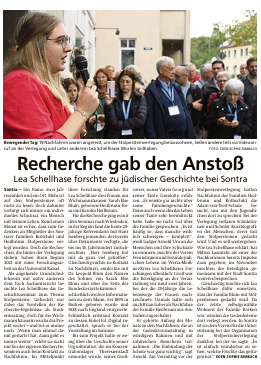
Photo Caption:
A moving day: 19 descendants had travelled to attend the Stolperstein installation, while others joined partly via video call to witness the ceremony and, among other things, hear Lea Schellhase’s words.
Photo: Eden Sophie Rimbach
Sontra – One name, two years and one place. There is often nothing more to read on the stumbling stones, but behind them there is always an individual fate, a person with his or her life. It has been about a month since stumbling stones were laid in memory of members of the Sontra Rotschild and Heilbrunn families. But the research behind the laying began in 2021 with a research project at the University of Kassel.
As a prospective primary school teacher with, among other things, the subject of general studies, Lea Schellhase attended the history seminar on the subject of stumbling blocks. The challenge was to present the research results as a course achievement, but for the Wichmannshausen resident, the project continued to grow – and still does. "Once you've started, it goes on and on," she experiences not only in her own research, but also in contact with descendants. For Lea Schellhase, the focus of her research was on three women from Wichmannshausen: Sarah Else Blum, née Heilbrunn, Rosa and Karolin Heilbrunn.
For the research, the seminar took her to Wiesbaden, and in the region, the now 25-year-old trainee teacher found someone in Hans Isenberg who already had documents dating back to the 16th century: "Mr. Isenberg helped me a lot." At the same time, she sought contact with descendants, discovered the name of Sarah Else Blum's son with Dr. Leopold Blum and finally further information about the man, who was born in Borken in 1895 and emigrated to England in 1938, via the website of the Federal Veterinary Association. Finally, contact was made with his grandson Ed. Digitally connected, he spoke at the presentation in the seminar.
Stumbling Stones Stumbling Stone Stumbling Stone Laying SontraDescendants with (from left) Hans Isenberg, Lea Schellhase and (second from right) Ludger Arnold
The laying of the stumbling stone was very emotional for the descendants, who can be seen here with (from left) Hans Isenberg, Lea Schellhase and (second from right) Ludger Arnold. © Eden Sophie Rimbach
Until the project, he had learned little about the story of his great-grandmother, who was murdered in the Theresienstadt concentration camp, his grandfather, his father Georg and his aunt Lieselotte. "He didn't know anything about his family history." Because even though his aunt's life impressed him very much, she didn't talk much about the family. "It is often the case that some people really remain silent – completely," says Ludger Arnold. In order to remember the people and their fates, the association Friends of Jewish Life in the Werra-Meißner district made Lea Schellhase's research public: There was a great deal of participation in the event about two years ago, at which the 25-year-old traced the lives of the women. At that time, Brian Luber had also joined in as a descendant of the Heilbrunn family from Australia. At the beginning of the month, he was one of the descendants who took part in the commemoration event in a dignified setting and with numerous visitors. "The involvement of the school was very important," says Arnold. On the morning before the stumbling stone was laid, descendants of the Heilbrunn and Rothschild families had visited the Adam von Trott School to talk to the young people there.
During the laying, students read out short biographies of the people who are commemorated with the stumbling stones. And it should continue. As Lea Schellhase explains, Milton Lasnitzki, as one of the descendants, has already given impulses for this; in November, the participants would like to discuss further with the city of Sontra.
At the same time, Lea Schellhase would like to work to ensure that the Blum family is commemorated with stumbling blocks. Since it was the last self-chosen place of residence of the Borken family, the memorial stones would be laid there. In Sontra, she is grateful to the association for its support in organising the laying of the stumbling stones, where she said: "It is simply wonderful to see what fruit it has borne out." (Eden Sophie Rimbach)
"An Important Sign to Set”
Student Council of Sontra’s Adam-von-Trott School Donates for a Stolperstein
Written by: Eden Sophie Rimbach in the Sontra News on 8th October 2025 Photo by: Stadt Sontra / nh
Sontra – Creating spaces of remembrance and making history visible: this is the commitment the student council of the Adam-von-Trott School in Sontra has taken on and intends to continue in the future. The students recently financed the installation of a Stolperstein, which was laid in September in memory of a member of the Heilbrunn family of Rothschild. In addition to donating €120, the student council has also assumed responsibility for the ongoing care of the Stolperstein.
Student spokesperson Maria Reuss recalls the strong enthusiasm surrounding the vote on both the donation and the commitment. Following the student council’s decision, student representative Maren Rudolph became actively involved in the Stolperstein project. The initiative was further supported by the Adam-von-Trott School, the Kurzberg Youth Centre, people with disabilities, and children and adults who laid white roses in remembrance.
The funds were raised through a waffle sale organised by the student council. The campaign proved highly successful, with strong participation in both baking and selling, ultimately raising more than €120.
The importance of the student council’s engagement becomes clear in the words of Maria Reuss: “It is very important that this event takes place.” She explains that the goal is to actively contribute to remembrance.
Maren Rudolph adds that the students want to make a meaningful contribution. At a time when donations and the maintenance of Stolpersteine are becoming increasingly challenging, the student representatives emphasise how essential it is to “set a visible sign.” The student council, Reuss notes, stands firmly for diversity, stating that “the student council can only thrive through diversity.”

Photo Caption:
A Stolperstein was financed by the student council. The donation was handed over (second from left) by Maria Reuss and Marie Gonnermann at the Sontra town hall to (left) Thomas Eckhardt and Ludger Arnold.
Photo: Stadt Sontra / nh
At the outset of their involvement, student spokespersons Maria Reuss and Marie Gonnermann officially presented the donation at Sontra Town Hall to Deputy Mayor and First City Councillor Thomas Eckhardt, as well as organiser Ludger Arnold. Both spokespersons - currently studying in Würzburg - expressed their sincere gratitude for the careful organisation and sensitive approach. They unanimously described Stolpersteine as powerful symbols of remembrance and as expressions of responsibility and historical awareness among students. It therefore comes as no surprise that the student council, led by Maria Reuss, can envision continuing to take responsibility for maintaining Stolpersteine in the future. Many members of the council have expressed interest in undertaking even larger projects. The student spokesperson also highlighted with pride that the council meets once every quarter to discuss Stolpersteine and to ensure that they remain clearly visible.
Together for Remembrance
Stolperstein laying in Sontra to continue - Residents and school to conduct research
Written by: Eden Sophie Rimbach in the Werra Rundschau /Eschwege on 17th April 2026

Photo Caption:
Descendants of the Heilbrunn (pictured here) and Rothschild families took part in the Stolperstein laying both in person and digitally.
Sontra - As the names and short biographies of the ten Jewish residents of Sontra are read aloud - those now memorialized with Stolpersteine (stumbling stones) - it is a particularly emotional moment. This moment is shared by 19 of their descendants who traveled to Germany for the occasion, as well as students from the Adam von Trott School, organizers, numerous participants from Sontra and the region, and descendants participating via video call. For those involved, the impressions and emotions from September 1, 2025, still resonate.
It is now certain, the research into Jewish people in Sontra and its districts will continue, as will the memorialization with Stolpersteine. This is the result of an exchange of ideas organized by all the cooperation partners behind the recent Stolperstein laying. In the Protestant parish hall in Sontra, organizer Ludger Arnold and Lea Schellhase—whose research work provided the initial spark for the project—gave a retrospective look.
Arnold explained that the researched biographies of the ten individuals being memorialized will be made digitally accessible. The Adam von Trott School is also committed to this effort, having significantly contributed to the day alongside the city, the Protestant church congregation, and various donors. Students from the school honored the ten residents by reading their short biographies and laying photos and roses. Shortly beforehand, descendants visited the school to talk with students about their family histories and the significance of the day. This was described as something that "truly moved the students in a lasting way," while the involvement of the young people also meant a great deal to the families.
Dr. Martin Arnold, chairman of the "Friends of Jewish Life in the Werra-Meißner District," spoke about the immense importance of remembrance and visiting former homes for descendants. He noted that interest among younger generations is not decreasing, but rather increasing. "We are pleased with every person who becomes active locally and provides support," he said regarding the memorial work, especially in light of the current political situation.
The participation of interested people in Sontra will be required for the laying of further Stolpersteine. Michael Sawosch, chairman of the church council, suggested that a group of interested citizens could meet once a month for collective research. The evening concluded with the decision that students should also be involved. When Ludger Arnold asked if the church would provide a meeting space, Pastor Stephanie Schmidt and Sawosch responded with a clear yes.
Contact details for people wishing to participate in this research group will follow. Ludger Arnold already presented a website created by descendants of the Heilbrunn and Rothschild families to share their family stories and their perspectives on the Stolperstein project.
Further Information: sontra2025.wixsite.com/heilbrunn
EDEN SOPHIE RIMBACH